Some values appear constantly in water reports, air-quality data and laboratory certificates. Rather than recalculating each time, it helps to memorise the common ones. This guide works through the ppb to ppm conversion figures people look up most, supplies a full reference table, and shows how to verify any result quickly.
How many PPM are in 1 PPB?
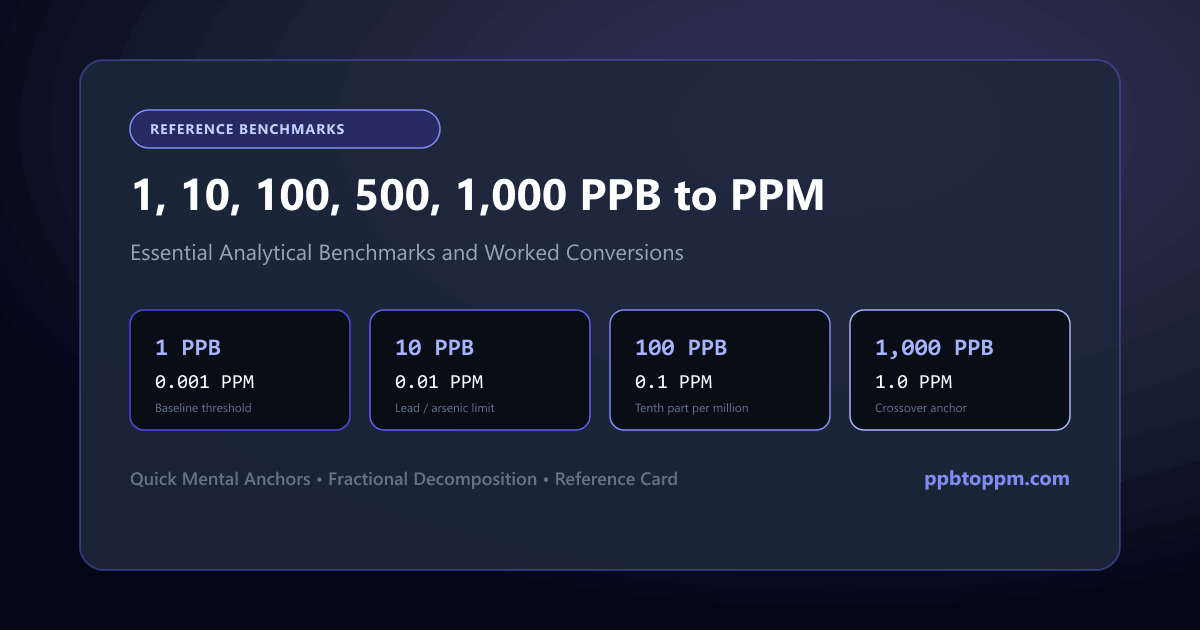
1 ppb to ppm gives 0.001 ppm. This is the foundational value from which every other conversion follows, since one ppm contains exactly one thousand ppb by definition.
Written as a decimal, 0.001 carries two leading zeros, which already illustrates why ppb exists as a separate unit. At this magnitude the ppm figure becomes awkward to read and easy to mistranscribe. Many laboratories set their reporting threshold precisely here: results below one ppb are typically flagged as below the limit of quantification rather than assigned a numerical concentration value.
How many PPM are in 10 PPB?
10 ppb to ppm produces 0.01 ppm. Simply shift the decimal point three places to the left from 10, giving one hundredth of a ppm.
This level appears frequently in drinking-water contexts. Several regulatory limits for heavy metals sit at or near ten ppb, making it a familiar benchmark for anyone reading water testing certificates. Because the value is a clean power of ten, it also serves as a convenient mental anchor: if you remember that 10 ppb equals 0.01 ppm, you can scale to neighbouring concentration values without a calculator.
How many PPM are in 100 PPB?
100 ppb to ppm equals 0.1 ppm, or one tenth of a part per million. The arithmetic remains a simple division by one thousand.
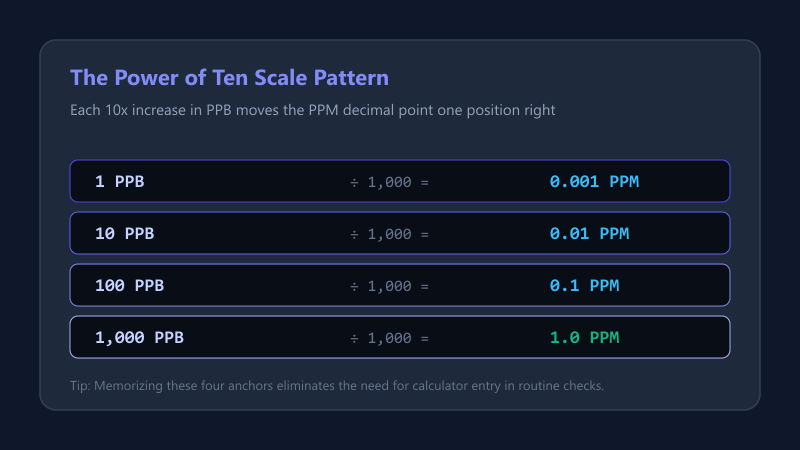
| PPB | PPM |
|---|---|
| 1 | 0.001 |
| 10 | 0.01 |
| 100 | 0.1 |
| 1,000 | 1 |
Notice the pleasing pattern across this conversion table: each tenfold increase in ppb moves the ppm decimal one place right. These four rows cover a remarkable proportion of everyday trace concentration examples, and memorising them removes the need for most lookups entirely.
How many PPM are in 500 PPB?
500 ppb to ppm yields 0.5 ppm, exactly half of one part per million. Since 500 is half of 1,000, and 1,000 ppb equals one ppm, the answer follows without any formal calculation.
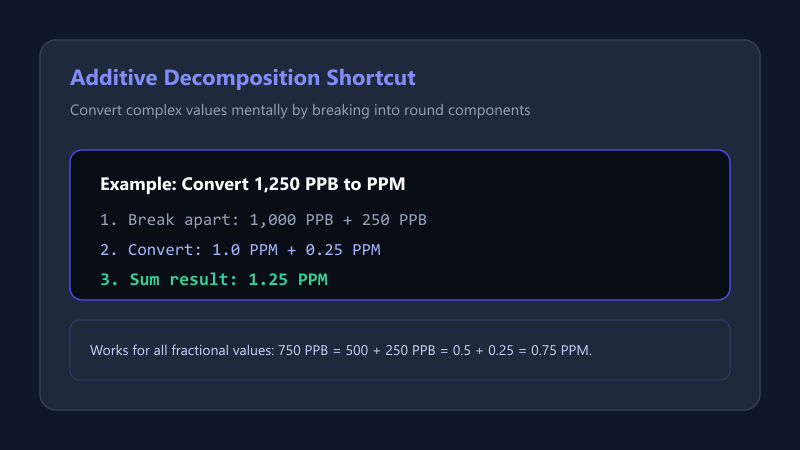
This shortcut extends usefully to other round figures. A value of 250 ppb gives 0.25 ppm, and 750 ppb gives 0.75 ppm. Working with fractions of one thousand often proves faster than dividing, particularly for mental estimates during a site visit or a meeting. The approach works for any ppb quantities that relate simply to the thousand.
How many PPM are in 1,000 PPB?
1,000 ppb to ppm gives exactly 1 ppm. This is the crossover point where the two units produce identical-looking numbers with different labels.
“One thousand ppb, one ppm. The anchor for every other value.”
Above this threshold, ppm generally produces more readable figures. A reading of 3,500 ppb is usually better expressed as 3.5 ppm, though laboratories that maintain unit consistency across a concentration reference series may choose otherwise. Either way, recognising this pivot point makes scanning mixed-unit reports considerably faster.
How can common PPB values be converted quickly?
Move the decimal point three places to the left. For whole numbers, this means inserting leading zeros as required, and no multiplication or division is needed at all.
| PPB | PPM |
|---|---|
| 5 | 0.005 |
| 25 | 0.025 |
| 75 | 0.075 |
| 150 | 0.15 |
| 350 | 0.35 |
| 800 | 0.8 |
For values that are not round, break them apart. To convert 1,250 ppb, handle 1,000 ppb as 1 ppm and 250 ppb as 0.25 ppm, then add for 1.25 ppm. This decomposition method handles almost any numerical conversion without a calculator and reinforces the underlying relationship.
How can a PPB-to-PPM reference table simplify calculations?
A printed conversion reference removes calculation entirely for recurring values. You locate the ppb figure in the left column and read the equivalent across, which takes about a second compared with perhaps ten for a calculator entry.
Build the table around your actual working range rather than trying to cover everything. Someone monitoring drinking-water metals needs rows between 1 and 100 ppb; an industrial emissions analyst might need 100 to 10,000. Twenty well-chosen rows beat two hundred generic ones. Laminate it and fix it near the workstation, since a loose sheet disappears within days in most laboratory environments.
How should very small converted values be written?
Values below 0.001 ppm accumulate leading zeros fast and become genuinely difficult to read accurately. A figure such as 0.00025 ppm invites transcription errors every time it moves between documents.
Two remedies exist. The first is scientific notation, writing 2.5 × 10⁻⁴ ppm instead. The second, usually preferable, is simply keeping the value in ppb where it reads as 0.25 ppb. Choose whichever convention your organisation follows consistently, and apply it across the whole concentration chart rather than switching format partway through a table.
How can you check a conversion without repeating the calculation?
Count decimal places. Your ppm figure should have the decimal point exactly three positions further left than the ppb figure, which is a visual check requiring no arithmetic.
Magnitude estimation supplies a second safeguard. The ppm result must always be smaller than the ppb input, never larger. If 250 ppb appears to give 250,000 ppm, the operation was inverted. These two checks together catch essentially every conversion error and take perhaps five seconds combined, which is negligible against the cost of a wrong figure reaching a report.
Case Study: The Laminated Card
A regional water laboratory processed roughly four hundred samples monthly, with results arriving in ppb and client reports required in ppm. Technicians converted each value individually, and a quarterly audit found eleven transcription errors across one year.
Conclusion
You now know the common ppb to ppm conversions that appear most often in practice. One thousand ppb equals one ppm, and everything else scales proportionally from there.
Memorise the four anchor values of 1, 10, 100 and 1,000 ppb, then derive the rest. A conversion guide on the wall handles the remainder faster than any calculator.